On this page
If you just want to listen tonight, skip to the feeds below. If you own a scanner that stopped working, the section on the 2023 switch explains what happened and how to fix it.
Listen live
Three Dallas police feeds are worth following. The all divisions feed is the busiest by far. If it feels like too much at once, the single division feeds are much easier to follow, especially when you are new to it.
What happened in 2023
For more than 25 years Dallas ran the same public safety radio system. By the early 2020s it was worn out, and the city replaced it with a Motorola P25 network. The changeover finished in May 2023, with more than 10,000 radios reprogrammed for city users.
The new system is big. According to the city, it runs on 29 towers around Dallas plus 3 more sites in East Texas, with more than 650 transmitters. Irving, Garland, Sachse, Mesquite, DeSoto, Dallas County, Parkland Hospital and Texas Instruments all share the tower infrastructure.
When the switch happened, plenty of listeners assumed the police had gone dark. The city addressed that directly in a July 2023 memo to the council:
All primary dispatch channels on the new P25 system are unencrypted and are publicly available transmitted radio channels. This has not changed.
What did change was the format. The traffic went fully digital, and the busiest talkgroups use P25 Phase II. An analog scanner hears nothing, and many older digital scanners that only decode Phase I hear very little.
What you can hear today
| Agency | Main dispatch | Encrypted |
|---|---|---|
| Dallas Police primary dispatch | Open | Tactical units such as SWAT and narcotics |
| Dallas Fire-Rescue and EMS | Open | Rarely |
| Dallas County Sheriff's Office | Partial | Some operational talkgroups reported encrypted |
| Suburban police on NTIRN | Partial | Varies city by city; many are encrypted |
Dallas sits in a middle ground that has become common in big cities. Routine dispatch is open, so you hear calls being assigned, units going en route and officers clearing. Specialized units talk on encrypted channels. Listener estimates put the open share of Dallas police traffic at around three quarters.
The suburbs are a different story. Several cities around Dallas on the regional network encrypt their police channels completely, so check the individual city before you buy a scanner for one of them.
How the radio system fits together
Scanner databases treat the Dallas system as one layer of the North Texas Interoperable Radio Network, known as NTIRN. NTIRN is a regional P25 Phase II network owned by a group of cities including Fort Worth, Arlington, Irving and Grand Prairie, and it reaches into Tarrant, Dallas, Denton, Johnson, Ellis and Parker counties.
For a listener that has two practical effects. First, a scanner programmed for NTIRN can follow Dallas and Fort Worth area agencies on the same system. Second, when you look Dallas up on RadioReference, you will find it under NTIRN (system 7349) rather than as a standalone city system.
We are not printing control channel frequencies here. The Dallas layer uses simulcast across many towers, and the right site depends on where you live. The live database stays current in a way a static list never will.
During regional emergencies you may also hear the national interoperability channels.
| Channel | Frequency (MHz) | Use |
|---|---|---|
VCALL10 | 155.7525 | VHF calling |
VTAC11 | 151.1375 | VHF tactical |
VTAC12 | 154.4525 | VHF tactical |
UCALL40 | 453.2125 | UHF calling |
UTAC41 | 453.4625 | UHF tactical |
8CALL90 | 851.0125 | 800 MHz calling |
8TAC91 | 851.5125 | 800 MHz tactical |
8TAC92 | 852.0125 | 800 MHz tactical |
Source: CISA National Interoperability Field Operations Guide (NIFOG).
Choosing a scanner for Dallas
The short version: you need P25 Phase II, and simulcast performance matters more here than in most places because of how many towers the system uses.
| Scanner | Type | Works here | Simulcast | Good fit for |
|---|---|---|---|---|
| Uniden SDS100 | Handheld | Yes | Excellent (True I/Q) | Serious listeners in busy simulcast areas |
| Uniden SDS150 | Handheld | Yes | Excellent (True I/Q) | Newer version of the SDS100 |
| Uniden SDS200 | Home or car | Yes | Excellent (True I/Q) | Best home or vehicle option |
| Uniden BCD436HP | Handheld | Yes | Fair | Budget digital, lighter simulcast areas |
| Uniden BCD536HP | Home or car | Yes | Fair | Budget digital base |
| Whistler TRX-1 / TRX-2 | Handheld / base | Yes | Fair | Whistler users |
| Uniden BCD325P2 | Handheld | Yes | Fair | Older budget digital handheld |
| Uniden BC125AT | Handheld | No | No | Analog only: aviation, ham, some fire paging |
| Baofeng UV-5R | Two-way radio | No | No | Not a scanner, cannot decode digital |
Inside Loop 12 and around downtown, the SDS series earns its price. Its True I/Q receiver deals with simulcast distortion far better than older designs. In the suburbs, or if you mostly want fire and EMS, a BCD436HP or BCD536HP will usually do the job.
If your scanner is Phase II capable but still sounds broken up, the problem is usually simulcast distortion rather than encryption. Try a different site, move the antenna, or lower the gain before giving up.
Setting it up
- Update your scanner's database first with Uniden's free Sentinel software for your model.
- Set your location by ZIP code or GPS so the scanner picks the Dallas layer sites nearest you.
- Enable law dispatch, fire dispatch and EMS dispatch service types.
- Turn on encrypted audio muting if your model has it, so silent encrypted talkgroups don't stop the scan.
If you prefer building from scratch, the talkgroup list for the Dallas layer is on RadioReference under NTIRN. Dallas police division dispatch talkgroups are the ones most feeds carry.
Big nights on the Dallas scanner
Some events stay with local listeners. The July 7, 2016 ambush downtown, in which five officers were killed, played out on the radio in real time. The October 2019 tornado that tore through North Dallas kept fire and police busy through the night. More recently the May 28, 2024 windstorm knocked out power to hundreds of thousands of homes, and the radio filled with calls about downed trees and lines for days.
Legal in Texas
Listening to unencrypted police radio is legal in Texas and doesn't need a license. Don't transmit on public safety frequencies, and don't use what you hear to interfere with police work or commit a crime.
Nearby counties. Radio traffic does not stop at the county line, especially on interoperability channels. Guides for neighboring counties are listed here as they are published, and the full list is on our Texas page.
Frequently asked questions
Is Dallas police radio encrypted?
Not the main dispatch channels. In its July 2023 memo on the new radio system, the City of Dallas said all primary dispatch channels remain unencrypted and publicly available. Tactical units such as SWAT and narcotics are encrypted.
Why did my scanner stop working in Dallas?
The city moved to a new Motorola P25 system in May 2023. It carries its busiest traffic in P25 Phase II, so analog scanners and Phase I only scanners lost the police channels. A Phase II capable scanner with an updated database fixes it.
What scanner do I need for Dallas?
One that decodes P25 Phase II and handles simulcast well, such as the Uniden SDS100, SDS150 or SDS200. Budget Phase II models like the BCD436HP work in many parts of the county.
Can I listen to Dallas police online for free?
Yes. Broadcastify carries several Dallas police feeds, including an all divisions dispatch feed (46336) and single division feeds such as 1 Central (5318).
Does Dallas County use the same system as Fort Worth?
They are tied together. RadioReference lists the Dallas system as a layer of the North Texas Interoperable Radio Network (NTIRN), the regional P25 Phase II network that also covers Fort Worth, Arlington, Irving and other cities.
Sources
- City of Dallas, memo: New Project 25 Land Mobile Radio Network (July 28, 2023)
- U.S. Census Bureau, QuickFacts: Dallas County, Texas
- City of Fort Worth, NTIRN plan (March 2022)
- RadioReference, NTIRN system 7349
- RadioReference, Dallas County database
- Broadcastify, Dallas County audio feeds
- CISA, National Interoperability Field Operations Guide
- Zip Scanners, Police scanner encryption guide (2026)
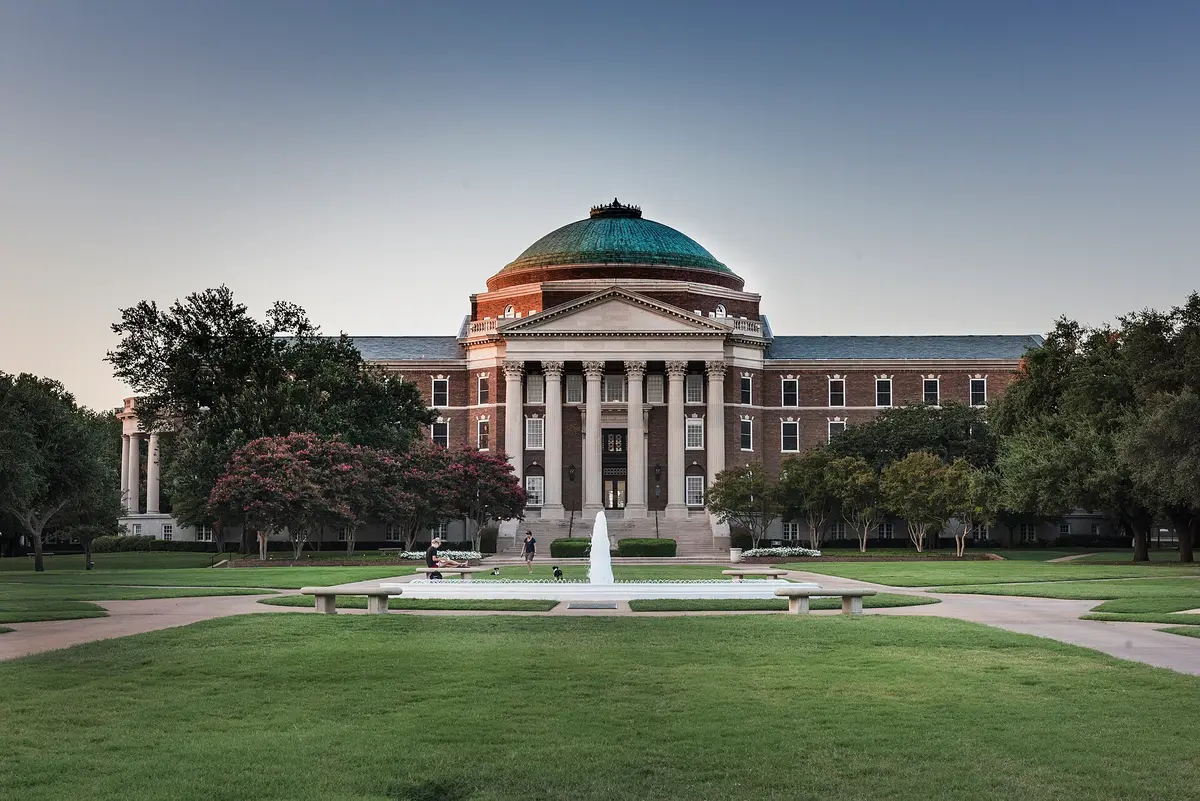
Images: photo by Carol M. Highsmith, Public domain via Wikimedia Commons; locator map David Benbennick, Public domain via Wikimedia Commons.